Clashes (The Point of View of Water)
Les heurts (le point de vue de l’eau), 2018
Research and exhibition projects created during an art residency with Vrille art actuel.

Camera obscura photographed in a room, at La Chapelle du quai, digital print, 2018.
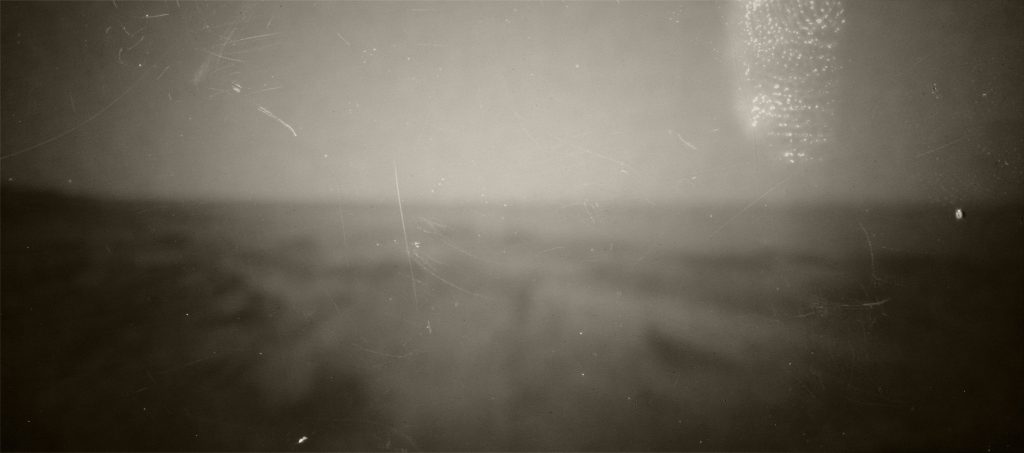
Les heurts (le point de vue de l’eau), pinhole photograph, digital print, 2018.
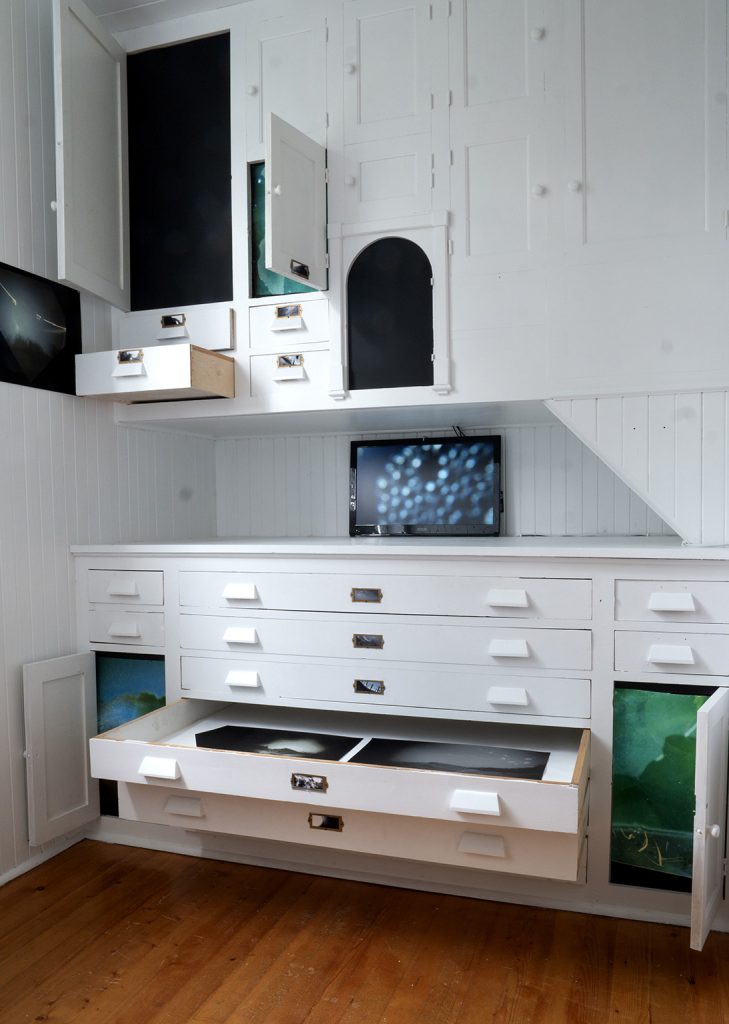
Photography, video and sound installation at La Chapelle du Quai de Rivière-Ouelle.
VRILLE ART ACTUEL
Exhibition-Residency, Cultural Mediation Workshop
June 10, 2018 – Workshop – Chapel of Rivière-Ouelle
June 23 to September 5, 2018 – Exhibition – Chapel of Rivière-Ouelle
What is the water’s point of view? Starting from this premise, an ecological sensitivity prompts her to consider that perspective and to step back from her own human point of view. Indeed, water is the primary medium through which the artist anchors herself in the site.
The oscillation between analog and digital photography generates surprising and unexpected visual encounters. In this way, she deliberately allows her work to bear the marks of fingerprints and traces of handling, water, natural effects, or intervention.
The residency unfolded in several stages. The research began at the Archives of the Côte-du-Sud, focusing on the history of the wharf and on texts dealing with water—more specifically, with sounds related to water. This resulted in photomontages combining historical texts with the first images she produced.
She then developed the first in a series of photographs taken underwater, followed by recordings of subaquatic sounds. Subsequently, on the shoreline, the artist installed the first of two series of pinhole cameras for a duration of one or two tides each. Handmade, these are black boxes pierced with a small hole that function as elementary photographic devices.
Following this, a camera obscura was installed in the presbytery bedroom, from which the artist produced several photographs. During the open house event, visitors discovered the darkroom. At the same time, they lent their voices and were recorded imitating the sound of water. This participatory component became integrated into the immersive sound environment of the sacristy. In keeping with this experimental spirit, the artist also filmed underwater by attaching her camera to a cable. As if fly-fishing, she cast her device into the waves to “fish for video.”
Finally, a gentle poetic and ambient soundtrack of human voices imitates the sound of water. Voices and waves become one in this auditory tide of water and merging humanity.